Facebook advertisers can target you with data you didn’t even list on your profile


Facebook advertisers can target you with data you didn’t even list on your profile


Facebook advertisers can target you with data you didn̢۪t even list on your profile


Facebook is sharing personally identifying information that you never submitted to the social network with its advertisers – and you can’t erase it from their records.
That’s from a paper (PDF) published by researchers at Northeastern University and Princeton University, who looked into how ad targeting works on Facebook.
Say you’ve got a mobile phone number and a landline, and you’ve listed only the former in your profile. If an advertiser has that number in their database, they can use it to target you with ads on Facebook. But if the advertiser has the landline number, they could target you with that as well.
How’s that possible, when you haven’t shared the landline number with Facebook? Well, you may not have given it to Facebook, but if you gave the number to a friend who’s also on the social network and has it saved in their address book (which Facebook has access to), then it can be associated with your profile.
As Gizmodo noted in its piece, Facebook has previously denied doing this. What’s more, if you give the site a mobile number solely for two-factor authentication, that can also be targeted by advertisers who have it listed in their database.
This isn’t the biggest infraction Facebook is guilty of, but it proves once again that the company doesn’t care about your privacy.
Here’s more damning context: WhatsApp co-founder Brian Acton – who sold the service to Facebook and resigned from the company last year – said that the company had plans to go against his vision and monetize the messaging service through advertising, even before the acquisition.
Facebook exec David Marcus, who formerly led Messenger and is now in charge of blockchain-based initiatives at the company, responded with a post in which he labeled Acton’s statements “a whole new standard of low-class.
Marcus added:
… Facebook is truly the only company that’s singularly about people. Not about selling devices. Not about delivering goods with less friction. Not about entertaining you. Not about helping you find information. Just about people.
I’ll leave it to analyst Ben Thompson to expertly sum up why Marcus is on the wrong side of this fight (captured in brief in the tweet below):
Gizmodo’s enlightening piece is worth a read; you may now delete your Facebook account.
Read next: Amazon Prime Reading brings a half-decent selection of free ebooks to India
Share:

Snoop around the garage Google was founded in with Street View


Snoop around the garage Google was founded in with Street View


Google's original garage is explorable on Street View, complete with CRT monitors.


To celebrate Google's 20th birthday, the tech giant is opening up the garage it was founded in, plus a bunch of other fun things.

The Google garage, as it was in 1998, is now explorable on Street View, complete with many CRT monitors, cables galore, and a washer and dryer that Google co-founders Larry Page and Sergey Brin gleefully used as part of their rent.
Page and Brin spent the winter of 1998 working out of Susan Wojcicki's garage, the YouTube CEO who back then was fresh out of school and was afraid of missing her mortgage payments.
The house on Santa Margarita Avenue in Menlo Park is now owned by the tech giant and no one lives there. 
If you can't get there, you can take a stroll inside "Google Worldwide Headquarters," which features a ping pong table, and a keyboard for music breaks.
Google has also unveiled easter eggs that will show up in search. 
When you look up certain (outdated) search terms like "mp3 file," "watch a dvd," "gettin' jiggy wit it," "page me," or "butterfly clip styles," you'll be recommended with things that are more relevant in 2018.
As announced earlier this week, Google Images has also launched a redesign on desktop, which features a new ranking algorithm that will prioritize content that is fresher and can be found on pages where the image is important, like a product page, for instance.
Share:

Facebook sued by former content moderator who says the job gave her PTSD


Facebook sued by former content moderator who says the job gave her PTSD


Facebook sued by former content moderator who says the job gave her PTSD


Facebook is being taken to court by a California woman who previously worked for the company as a content moderator, as she claims the work caused her to develop post-traumatic stress disorder (PTSD), reports Motherboard.
In her role as a contractor for Facebook through a company called Pro Unlimited, Selena Scola was tasked with identifying and removing content from the social platform that violated its Community Standards. That includes hate speech, images of graphic violence, self harm, bullying, and nudity and sexual content.
According to Scola’s lawyers, she developed PTSD as a result of “constant and unmitigated exposure to highly toxic and extremely disturbing images at the workplace.” They also alleged that Facebook doesn’t have proper mental health services and monitoring in place for its content moderators.
For its part, Facebook told Motherboard that it indeed provides mental health services to moderators at its own facilities and at those of its contractors. It also noted that it handles these concerns by addressing them during the training process, and by providing appropriate benefits and resources for mental wellness.
The dangers of content moderation for large-scale platforms like Facebook have been extensively documented, so the only thing surprising about this incident is that it’s taking place this far into the company’s lifetime. Microsoft faced a similar lawsuitlast January.
It’ll be interesting to see how this pans out, as it could have wider implications for companies that require content moderators, and for those who take up these roles around the world. Facebook currently has some 7,500 people working to identify and remove objectionable material. According to Moneycontrol, it’s expected to grow that number to 20,000, and is currently hiring people through contractors in India with annual salaries ranging from $3,100 to $5,500.
Scola’s lawsuit demands the creation of a “Facebook-funded medical monitoring program to facilitate the diagnosis and aquate treatment of Plaintiff and the class for psychological trauma, including but not limited to PTSD.” The case will is yet to be evaluated and pushed through by a judge in California.
We’ve contacted Facebook to learn more and will update this post if there’s a response.
Share:

Facebook sends Sphero robots so classrooms can apply coding education


Facebook sends Sphero robots so classrooms can apply coding education

Facebook CodeFWD Education Sphero


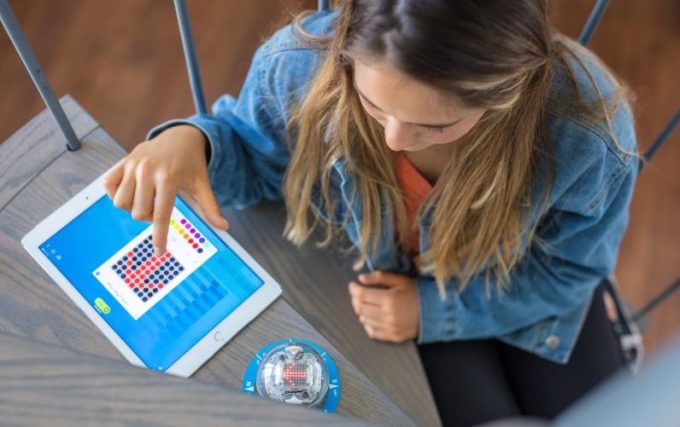
Program a robotic toy to move and you could be hooked on coding for life. That’s the idea behind Facebook’s  newest educational initiative called CodeFWD. It provides online coding tutorials for teachers and students powered by Code.org, and if classrooms finish those, they can apply to be sent a free Bolt robot from Sphero, makers of the popular animatronic R2D2 Star Wars toy. Students can then learn how to use block-based JavaScript to make Bolts roll if different directions, light up, and interact with each other.
CodeFWD’s launch comes alongside the debut of the social network’s new Facebook For Education website that could help Facebook repair its public image by touting its positive contributions to society. After a year of Cambridge Analytica, election interference, and digital well-being worries, Facebook’s brand needs all the help it can get.
Education.fb.com compiles Facebook programs including TechPrep for easing students in computer science, Oculus Next Gen and TechStart for getting VR headsets into classroom and college programs, Oculus For Good and LaunchPad for supporting philanthropic VR content and diverse creators, and Facebook’s own tools like Workplace and Groups for teachers.
One more new program launching this month called Engineer For The Week teaches teens applied computer science after school. Students build chatbots and games to support a local cause while learning the fundamentals of computational thinking over a three-week regimen of collaborating with Facebook’s own engineers. Engineer For The Week runs four times per year with the next cycle starting October 1st that culminates in a two-day hackathon at Facebook HQ.
Beyond bolstering Facebook’s brand, the coding education programs could supply Facebook’s engineering needs a decade later. “We know that it’s important to make sure we’re supporting the next generation of diverse talent. It can really widen the pipeline” says Facebook Education’s director Lauryn Hale Ogbechie. “I think it’s of benefit to any tech company and the industry more broadly. If we’re able to support students staying computer science . . . that will benefit everyone down the road.”
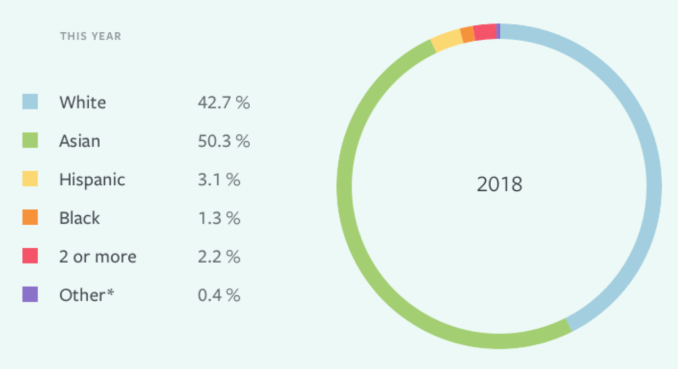
Right now, Facebook’s US staff is just 4.9 percent Latinx and 3.5 percent black. Looking at technical roles it’s even worse, with just 3.1 percent Latinx and 1.3 percent black. It’s only managed to nudge those numbers up slightly over the past five years.
To drive inclusivity in engineering from a younger age, Facebook has piloted the CodeFWD program at the Harlem Children’s Zone, and Austin’s  Latinitas. The company tells me it will continue to target underserved students, and the program is open to fourth grade to eight grade classrooms with credentialed teachers as well as registered non-profits that have Internet access and computers for students.
Facebook will pay for the $150 Sphero Bolt robot kits which are free for teachers (who need no prior programming experience), though it won’t say how many it plans to distribute. Once they and their classes complete the teacher-only I Do, teacher-student We Do, and student practice You Do coding tutorials and their quizzes, they can apply for a robot. Facebook will prioritize applications that expand computer science education to the underserved. And the company notes that “Facebook will have access to aggregate, anonymous usage data from Sphero” . It’s always ready to seize on new types of data.
Facebook’s philanthropic efforts like this are often overshadowed by its privacy and political scandals. The company’s heart is usually in the right place, even when it’s naive, clumsy, or ruthless in its execution. If anything, Facebook would benefit from a broader range of perspectives on which is the right path forward. Hopefully these education programs will see the wealth it’s accumulated today contribute to a more diverse set of leaders for tomorrow.
Share:

How 5G Could Transform Your Home Internet Connection


How 5G Could Transform Your Home Internet Connection


Verizon is about to launch home internet service using 5G. This new wireless standard isn’t just about faster data for your smartphone—it could finally offer competition for home internet, breaking the cable companies’ local monopolies and giving you a choice.

This is About Verizon, But It’s Not About Verizon

Verizon is the first company to deliver home internet service via 5G, so we’re talking about Verizon a lot in this article. We know the details of their service and can compare it to cable internet. But this isn’t an advertisement for Verizon.
AT&T also plans to launch home internet over 5G by the end of 2018. T-Mobile and Sprint are claiming they will launch a similar service if only the government lets them merge first.
This is all exciting. These are multiple companies that can compete with each other! It’s very unlike wired internet service in most places in the US, where there’s one big cable company.
Imagine having a choice between internet service providers. Competition might force Comcast to lift that data cap—or provide good customer service. Seriously, have you ever been to an old-school Comcast service center? It’s like going to the DMV. They’ve gotten better with their more upscale Xfinity stores, but most places don’t have those yet.

Why Internet Over 5G and Not 4G LTE?

5G is a newer, faster wireless standard that supersedes the current 4G LTE standard, just as 4G LTE replaced 3G. But 5G isn’t just for your smartphone.
You might wonder why everyone is talking about home internet over 5G. After all, no one was talking about home internet delivered over the current 4G LTE network that smartphones use. Is 5G that much faster?
Yes, yes it is. 4G has a theoretical maximum speed of 100 Mbps (megabits per second,) while 5G has a maximum speed of 10 Gbps (gigabits per second.) In other words, 5G is a hundred times faster than 4G at theoretical maximum speeds. Even taking these numbers with a grain of salt, it’s a huge leap.
5G also promises reduced latency. According to the specification, there’s a maximum latency of 4 ms (milliseconds) on 5G instead of 20 ms on 4G LTE today. That will deliver a better experience, too.
With these high speeds and low latencies, 5G looks like a strong competitor to the cable speeds offered by companies like Comcast/Xfinity, Charter, and Cox. 5G could be even faster than cable.

How Verizon’s Service Works

A Verizon “small cell” in Indianapolis.
Verizon is the first cellular carrier to launch a 5G home internet service product, which it’s calling “5G Home.”
Like with standard cable internet service, you’ll have a 5G Home modem that connects to Verizon’s servers. You can then attach this modem to your router and other devices so they can access the internet. That 5G modem sits in a window and communicates with Verizon wirelessly. There’s also an external modem that you can mount outside if there’s no good reception from the windows.
Your modem communicates with Verizon devices placed every 500 to 1000 feet in your neighborhood. These may be placed on streetlamp poles, for example. That’s because 5G takes advantage of “millimeter waves” for super-fast speeds. These waves can’t easily travel through solid objects, so the 5G network needs nearby “small cells”  to enable these fast speeds. 5G doesn’t have to use millimeter waves and small cells, but that’s where much of the speed improvement comes from.
Verizon promises typical speeds of about 300 Mbps and peak speeds up to 1 Gbps (1000 Mbps)—and no data caps. The service costs $70 a month if you’re not already a Verizon customer and $50 per month if you are.
I pay Comcast about $70 per month for about 150 Mbps, and that’s with a contract—Comcast will charge me more for this speed in the future. Comcast enforces a 1 TB data cap on me, too. So I’d jump at the chance to switch to 5G for home internet if it worked as promised.
Verizon is launching its 5G Home service starting October 1, 2018, in Houston, Indianapolis, Los Angeles, and Sacramento.

When Can I Get It?

If you don’t live in Houston, Indianapolis, Los Angeles, or Sacramento, you’ll have to wait a bit longer. Verizon hasn’t said which cities will be next for its 5G Home service or when it will expand. Verizon hasn’t announced the first cities it will launch mobile 5G in yet, either.
AT&T, however, is focused on rolling out its mobile network. AT&T’s CEO recently said Verizon is “fixated” on home internet. AT&T has been running internet service over 5G trials to households and businesses in South Bend, Indiana and businesses in Waco, Texas and Kalamazoo, Michigan, but those are just trials. AT&T plans to launch mobile 5G service in a variety of cities later in 2018.
T-Mobile says it wants to be the USA’s fourth-largest in-home internet service provider by 2024 if only the government will let it merge with Sprint. T-Mobile has announced plans to roll out mobile 5G in a variety of cities so customers can use it when the first 5G phones launch in early 2019. However, T-Mobile and Spring have announced no concrete plans for home internet service yet.
Sprint has also announced plans to launch its 5G network in a variety of cities and to bring the first 5G smartphone to the US in 2019.

What About Fiber?

Verizon technicians installing a 5G node.
Look, fiber is great. But it’s a significant investment. To lay fiber if it’s not already present, providers might have to dig up the streets. To lay fiber out to every home, they’ll have to dig up yards. Providers also need access to the utility poles, and that’s been a huge ordeal. Google Fiber has stalled because of the difficulties in getting access and the sheer investment required.
Wireless 5G internet service promises to be much easier and faster to roll out without all the digging up yards and political fights over utility pole access. All the last-mile connections to houses and businesses could happen wirelessly. Heck, if you’re putting the small cells on street light poles, you don’t even need to deal with utility poles.

Will 5G Bring Better Internet to Rural Areas?

We’re still not sure exactly how well 5G will work when extending service to less-dense rural areas and smaller towns. Verizon’s initial rollout is occurring in a few bigger cities, and those super-fast speeds will require nearby small cells.
5G could be a viable connection method for home internet service in rural areas, but it’d be slower without those small cells nearby. However, it could still extend dependable internet access to areas that don’t have a good alternative right now. It’s easier to roll out wireless internet access in a rural area than fiber—or even cable.
We look forward to seeing what happens with 5G in the next few years. We hope it will transform the way we access the internet. The US badly needs more competition between internet service providers, and wireless service could be the solution.


Share: